As an Amazon Associate this site earns from qualifying purchases.
Quick Picks: Replacement Jacks Worth Considering
If your diagnosis ends in "the motor is cooked," these are the three jacks in this guide, with the manufacturer-published specs that matter most when you are shopping a replacement.
| Jack | Manufacturer-stated lift capacity | Spec worth knowing when yours quits |
|---|---|---|
| Lippert 3,500 lb Electric A-Frame Trailer Tongue Jack, Black, 285318 | 3,500 lb | Lippert's listing cites helical-cut gears, 30 AMPs of power and a 12V motor, plus four integrated LED lights (Check Price on Amazon) |
| VEVOR Electric Trailer Jack | 4000 lbs | VEVOR's listing states the jack is equipped with a hand crank for emergency use in case of a power outage (Check Price on Amazon) |
| Pafessa 12V Electric Tongue Jack 3500lb A-Frame Heavy Duty Trailer Jack 18” Travel Add 4.5” with The Drop Foot & LED Light for Travel Trailer Camper,Protective Cover Included | 3,500 lb | Pafessa's listing describes a self-resetting 30A circuit breaker and manual operation using a supplied 11mm deep well socket (Check Price on Amazon) |
As an Amazon Associate we earn from qualifying purchases. This page contains affiliate links, and we may receive a commission if you buy through them — at no extra cost to you.
As an Amazon Associate, we earn from qualifying purchases.
Last Updated: September 2026
Short answer: work the electrical side before you blame the gearbox. Check battery state of charge, then the cable ends and ground path, then the overload protection, then the switch — and only after all of that assume the motor or screw has failed. A jack that clicks, a jack that hums, and a jack that is completely silent are three different problems, and the noise it makes is your first diagnostic clue.

- ELECTRIC TONGUE JACK - Skip the hand crank with push-button raising and lowering for A-frame RVs, travel trailers, utility trailers and cargo trailers; 3,500-lb. lift capacity
- TRAILER TONGUE JACK PERFORMANCE - Built with 30-amp power, a 12V motor and quiet, efficient helical-cut gears, this electric trailer jack delivers an 18" stroke with 10-3/4"
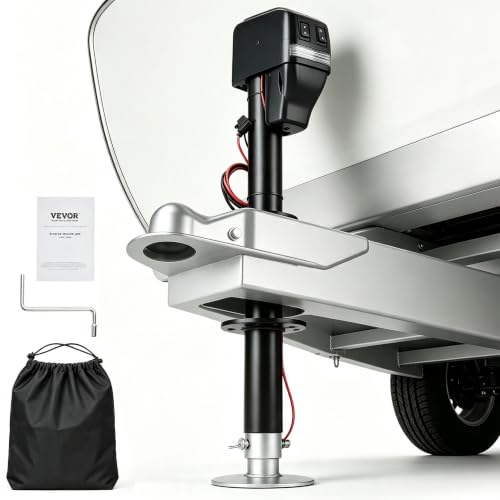
- 【Heavy-Duty Load Capacity】 The VEVOR electric trailer jack boasts an impressive lifting capacity of 4000lbs, making it a powerful tool for lifting tasks. Provide reliable support
- 【Quality You Can Trust】 Constructed from durable carbon steel with a protective coating, our power tongue jack ensures long-lasting performance and a new-like appearance. It's

- [Versatile Lift Range ] The Pafessa Tongue Jack has 3,500 pound lift/tongue wt capacity, fits 2.25” mounting holes on most A-Frame trailers and RVs. This trailer jack features 18”
- [Superior Efficiency] The electric trailer jack is acme threaded rod and high-precision metal helical gears inside ensure smooth and quiet operation.Working speed is 0.4in/second
The Problem: What the Symptom Is Actually Telling You
Strip away the branding and an electric tongue jack is a 12V motor turning a threaded screw through a gear set. There are only a handful of places a failure can live: supply voltage, wiring and ground, overload protection, the switch, the motor, or the mechanical drivetrain.
Manufacturer specifications make that concrete. Pafessa's listing states a 150W motor with an operating voltage range of 9V-16V, which tells you these jacks are engineered around a defined voltage window rather than "whatever the battery has left."
Current draw is the other half of the story. Lippert's listing describes 30 AMPs of power and a 12V motor for its Power Tongue Jack. A corroded ring terminal, a loose ground, or a battery sitting at storage voltage can all choke a draw that size long before the motor itself is at fault.
RV power jack clicking but not moving
Clicking with no movement is the classic low-voltage or high-resistance signature: the circuit is closing, but the motor cannot make enough torque to turn the screw under tongue weight. Treat it as a supply problem until proven otherwise, and start at the battery rather than the jack head. Our notes on trailer battery maintenance cover checking charge state properly.
It ran, then stopped part way
This is frequently protection working as designed, not a broken jack. Pafessa's listing describes a self-resetting 30A circuit breaker that triggers protection in 15 seconds against overloads, extended use (2+ minutes), or reaching travel limits — three separate conditions, only one of which is an actual overload.
Here's the practical inference: if you were holding the switch for a long run, or the jack had reached the end of its travel, an interruption may simply be the breaker doing its job. Let it cool and reset before you decide anything failed.
Trailer jack stuck extended
A jack stuck in the extended position is the scenario that strands people, because the trailer cannot be hitched or moved. This is exactly what a manual override exists for — and whether you have one depends on the model, so check your own manual before you improvise.
Step-by-Step: Tongue Jack Motor Troubleshooting
- Chock the wheels and stabilize the trailer first. Never work under a trailer supported only by its tongue jack; use rated stands and follow your trailer manufacturer's instructions.
- Confirm the battery is genuinely charged, not just connected. A battery sitting at storage voltage can leave a healthy jack acting dead.
- Inspect and clean every connection in the circuit — battery posts, ring terminals, the ground stud, and the connector at the jack. Corrosion adds resistance, and resistance kills torque.
- Check the ground path specifically. Pafessa's listing notes a 7 foot power cord with positive and negative wires for direct grounding, and that wire terminals are not included — a reminder that grounding on these jacks is an installation detail, not an assumption.
- Check the fuse or circuit breaker feeding the jack, per your model's instructions. If it is self-resetting, allow the cool-down period before retesting.
- Test the switch. Pafessa places its control on a toggle switch on the bottom of the motor housing, so know where yours actually lives before you go hunting.
- Listen and separate motor noise from movement. Motor spinning with no lift points toward the drivetrain; silence points back to the electrical side.
- If nothing moves, use the manual override to get the trailer usable, then arrange service or replacement.
- Stop and consult the manufacturer if the diagnosis lands inside the sealed gear housing. Guides like this can narrow the symptom; only the maker's service instructions can authorize an internal repair on your exact model.
Manual Override: Getting a Stuck Jack Moving
Manual override implementations differ, and the difference matters when you are stranded.
VEVOR's listing states that, in case of a power outage, the electric jack for trailers is equipped with a hand crank for emergency use. Pafessa takes the socket approach: its listing says the jack can be manually operated with the supplied 11mm deep well socket, accessed through the hole on top of the jack housing, and notes that a driver handle is not included.
That second detail is worth acting on now rather than in a dark campground. The supplied listing information for the Lippert jack does not state a manual override method; check the product's own manual for your unit.
Tools & Products You'll Need
Recommended Products: if troubleshooting ends with a dead motor or a seized screw, these three electric jacks are the ones covered in this guide (check each listing's stated mounting details against your own trailer's coupler before ordering). Match capacity to your trailer's tongue weight, not to your total trailer weight.
Lippert 3,500 lb Electric A-Frame Trailer Tongue Jack, Black, 285318 — Best for owners who want a drop-in replacement with hardware included
Lippert's listing rates this jack at 3,500 lb lift capacity, with helical-cut gears, 30 AMPs of power and a 12V motor. The company also states the jack arrives complete with all necessary hardware and pins, which removes one common source of installation-day frustration.
Night visibility gets specific attention: Lippert describes four integrated LED lights that illuminate the ball and coupler. Lippert also cites heavy-gauge steel construction, a textured housing that prevents chips and cracks, and a black powder-coat finish.
Suits: an A-frame owner replacing a failed jack who wants the hardware in the box. Note the limits: the supplied listing information does not state a manual override method, a duty-cycle rating, or a travel length.
VEVOR Electric Trailer Jack — Best for buyers who want the highest published capacity of these three
VEVOR's listing states a lifting capacity of 4000 lbs, which is the highest manufacturer-published figure among the three jacks here — useful headroom if your tongue weight sits close to a 3,500 lb rating. The listing gives a 9.84"-33.85" range for the jack.
Weather protection is a stated focus: VEVOR describes carbon steel construction with a protective coating designed to withstand splashes and tough outdoor conditions, and includes a sunshade waterproof cover against water and UV. Read that as splash and weather resistance, not submersion.
One genuinely practical design note: VEVOR says a 90° rotating installation hole prevents interference with the tailgate. Suits: RV, horse, utility and yacht trailer owners who want capacity margin and a bundled cover.
Pafessa 12V Electric Tongue Jack 3500lb A-Frame Heavy Duty Trailer Jack 18” Travel Add 4.5” with The Drop Foot & LED Light for Travel Trailer Camper,Protective Cover Included — Best for owners who want documented overload protection and a defined manual override
This is the most thoroughly specified listing of the three, and that matters for a troubleshooting-minded buyer. Pafessa lists a 3,500 pound lift/tongue weight capacity, 18” of travel plus a 6” diameter adjustable footpad that adds 4.5” extension, and a fit for 2.25” mounting holes on most A-Frame trailers and RVs.
The protection story is spelled out: a self-resetting 30A circuit breaker triggering in 15 seconds against overloads, extended use (2+ minutes), or reaching travel limits. Pafessa also states a 150W motor with a 9V-16V operating range. The Pafessa 12V Electric Tongue Jack 3500lb A-Frame Heavy Duty Trailer Jack (B0FMFDDV5J) listing gives two speed figures that contradict each other — a working speed of 0.4in/second and travel of 10” in 50 seconds, which works out to 0.2in/second — so treat the lift speed as unconfirmed and check with the manufacturer if cycle time matters to you.
Maintenance access is included too. Pafessa's package is listed as including high-strength nuts, 3/8” bolts, washers, a weather resistant cover, an emergency crank socket and installation/operating instructions, with an easy access grease fitting to add lubricant to the jack screw. Note the limits: a driver handle for the override socket and wire terminals for the 7 foot cord are not included.
Tips for Best Results
- Buy to tongue weight with margin. Capacity ratings are published lift ratings, not a licence to run at the number every time.
- Keep the override tool with the trailer. Pafessa supplies an 11mm deep well socket but not a driver handle — that gap is trivial to close at home and miserable to discover on the road.
- Lubricate if the manufacturer provides for it. Pafessa's grease fitting exists precisely so the screw does not run dry.
- Fit the cover. Both VEVOR and Pafessa include weather covers in their listings; a covered head is a head that is not collecting standing water.
- Check for recalls on towing components through NHTSA, the vehicle-safety regulator that handles trailer and towing equipment recalls, before you write off a symptom as normal wear.
Common Mistakes to Avoid
- Holding the switch at the end of travel. Pafessa explicitly lists reaching travel limits as a breaker-trip condition; forcing past it helps nobody.
- Assuming water resistance means waterproof. VEVOR's coating claim is framed around splashes and outdoor conditions, and Pafessa's is a water-resistant motor and gear housing.
- Replacing the motor before testing the ground. High-resistance grounds mimic dead motors convincingly.
- Improvising an internal repair from a product listing. A feature bullet is not a service manual.
- Using the tongue jack as a support stand. It is a lifting device; leveling and stabilizing are separate jobs, covered in our RV pre-trip checklist.
How We Research
This website does not perform product research. For this guide, product claims come from two source types only: Amazon Creators API verified product records and the product listing feature bullets published for each ASIN, both retrieved on 10 September 2026. Where a figure is not present in those records — duty cycle, warranty length, weight — we say so rather than estimating.
Final Verdict
If your jack clicks but will not move, the highest-probability fix is electrical and free: charge the battery, clean the connections, verify the ground. Do that before spending anything.
If it is truly dead, the Pafessa jack is the one whose published specification set best matches a troubleshooting-conscious buyer, because it documents the exact things that go wrong: a self-resetting 30A circuit breaker with defined trip conditions, a stated 9V-16V operating range, an 11mm socket manual override, and a grease fitting for the screw. If your tongue weight sits uncomfortably near 3,500 lb, VEVOR's published 4000 lbs capacity is the reason to look there instead. And if you want a like-for-like A-frame swap that ships with all necessary hardware and pins, Lippert's 3,500 lb unit is the straightforward choice.
Related Resources
- Trailer battery maintenance
- Weight distribution hitch setup
- RV pre-trip checklist
- CPSC consumer product safety for recall notices
- USA.gov consumer protection for purchase disputes
Sources & Methodology
Nobody at this website lifted a trailer, wired a jack, or put a meter on anything — there is no lab here and no test fleet. What this guide is built on is close reading of Amazon Creators API verified product records and the manufacturer-published listing feature bullets for ASINs B00JMHHF9Q, B0CCNHZ91W and B0FMFDDV5J, retrieved 10 September 2026, cross-referenced against how a 12V screw jack actually fails. That is enough to tell you which jacks publish an override method, a protection threshold and an operating voltage window — the specs that decide whether a roadside failure is a ten-minute inconvenience or a tow — but it cannot tell you how any of these units hold up over five seasons of road vibration, and we are not going to pretend otherwise.