As an Amazon Associate this site earns from qualifying purchases.
Quick Picks
| Product | Role in the setup | Key published spec | Link |
|---|---|---|---|
| CURT 17422 Short Trunnion Bar Weight Distribution Hitch with Sway Control | The complete system for heavier travel trailers | Rated up to 15,000 lbs. with 28-3/8" trunnion-style, forged steel spring bars, per the listing | Check Price on Amazon |
| CURT 17112 Weight Distribution Hitch Lift Handle | Leverage for snapping brackets up under tension | Steel construction, corrosion-resistant powder coat, one handle included, per the listing | Check Price on Amazon |
| Youyikoo Heavy Duty Weight Distribution Hitch Hookup Brackets | Replacing worn or damaged trailer-frame brackets | Iron construction with black powder coating, sold as 2 pcs, bolt-on install, per the listing | Check Price on Amazon |
As an Amazon Associate we earn from qualifying purchases. This page contains affiliate links, and we may receive a commission if you buy through them — at no extra cost to you.
As an Amazon Associate, we earn from qualifying purchases.
Last Updated: September 2026
Here's the short answer: setting up a weight distribution hitch is a measuring job, not a muscle job. You record your tow vehicle's front and rear fender heights unhitched, couple the trailer, then adjust the head's ball angle (washer count or tilt) and the spring bar tension until the front fender returns close to its unloaded measurement. Everything else — sway control, torque, road testing — comes after those numbers line up.
This is a research-based guide. This website does not do product research, and no one here has installed, towed with, or handled the products named below. Product facts come from the supplied Amazon listing records, and every one of them is attributed.
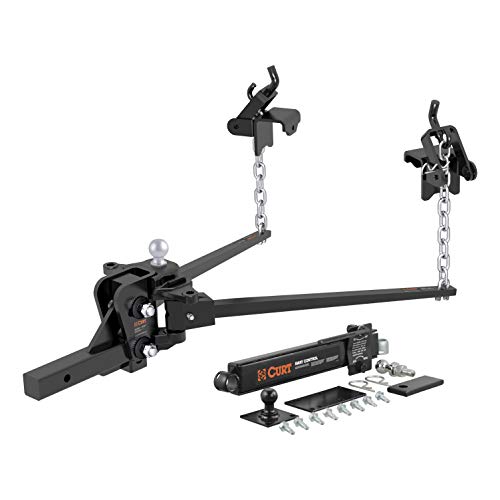
- Levels tow vehicle and trailer by redistributing a portion of the tongue weight
- Includes sway control kit #17200 to help reduce trailer sway

- Allows for easy leveraging of weight distribution
- Strong steel construction

- 【Ensuring Safe Driving】: This heavy-duty Weight distribution hitch hookup bracket effectively distributes the trailer's load across all four wheels of your towing vehicle, whether
- 【Durable Iron Construction】: Crafted from sturdy iron, this hitch bracket boasts high strength and hardness, effectively resisting damage and scratches. The black coating on its
The Problem: A Level-Looking Rig Is Not Necessarily a Tuned One
A loaded travel trailer pushes tongue weight onto the tow vehicle's rear axle. That squats the back, lifts the front, and lightens the steering axle exactly when you need it most. A weight distribution hitch uses spring bars as levers to shift part of that tongue weight forward onto the tow vehicle's front axle and back onto the trailer's axles.
CURT describes the 17422's job in exactly those terms: it levels tow vehicle and trailer by redistributing a portion of the tongue weight [S4]. The word portion matters. You are not eliminating tongue weight, you are relocating some of it. Get greedy and over-tension, and you unload the drive axle instead.
The two variables you actually control are ball angle (how far back the hitch head is tilted, set by washers or a tilting head) and spring bar tension (how far the bracket chains or brackets are cranked up). Confuse them and you will chase your tail all afternoon.
Step-by-Step: How to Set Up a Weight Distribution Hitch
- Load the rig the way you actually tow it. Full fresh water if you travel with it, gear stowed, propane on. Setup done on an empty trailer is setup for a trailer you never tow.
- Park on flat, level ground. A driveway slope will corrupt every measurement that follows. Chock the trailer wheels.
- Measure fender height unhitched. With the tow vehicle uncoupled, measure from the ground to a fixed point on the front fender lip and the rear fender lip. Write both numbers down. This is your baseline for measuring fender height when hitching a travel trailer.
- Couple the trailer with no spring bars installed. Lower the coupler onto the ball, latch, and connect safety chains. Measure both fenders again. The front will have risen; the rear will have dropped. The difference is what you are about to correct.
- Set the ball angle first. Raise the trailer tongue with the jack until the hitch head is unloaded, then set the head tilt per the manufacturer's instructions for your unit. CURT states the 17422 has a heavy-duty, formed head that can be adjusted for precise leveling [S4]. Start with the manufacturer's recommended washer count or tilt; do not guess a number off the internet.
- Install the spring bars and apply tension. Raise the tongue jack to lift the rear of the tow vehicle, hook the bars into the trailer-frame brackets, then snap the brackets over. This is where a lift tool earns its keep.
- Lower the jack and re-measure. Drop the trailer fully onto the suspension and measure both fenders again. The goal is to restore the front fender to close to its unhitched height, following your hitch manufacturer's stated target.
- Adjust and repeat. Too little front-end restoration means more tension or more ball angle. Too much means back off. Change one variable at a time and re-measure — that is the whole discipline.
- Install and adjust sway control last. The 17422 ships with sway control kit #17200, and CURT says the sway control mounts on built-in attachment tabs on the head [S4]. Fit it after distribution is dialed in, not before.
- Road test on a quiet route. Check bracket security, chain condition, and coupler latch after the first few miles, then again at your first fuel stop.
Tools and Products You'll Need
CURT 17422 Short Trunnion Bar Weight Distribution Hitch with Sway Control — Best for owners of heavier travel trailers who want distribution and sway control in one published package
The reason this one leads the list is the spec, not a hunch: CURT rates the 17422 for use up to 15,000 lbs. and equips it with 28-3/8" trunnion-style, forged steel spring bars [S4]. Trunnion bars mount into the head rather than hanging under it, which typically buys ground clearance and makes the bars easier to seat — a reasonable inference from the mounting style, not something observed here.
For the setup process specifically, the adjustable formed head is the part that matters, because ball angle is your primary leveling control [S4]. And because sway control kit #17200 is included and mounts on the hitch's own tabs, you are not sourcing a separate friction bar and figuring out where to bolt it [S4].
Strengths: Adjustable head for ball-angle tuning; forged steel trunnion bars at a stated 28-3/8"; included sway control [S4].
Limitations to weigh: The listing specifies a 2-inch shank and a 2-5/16-inch ball, so a trailer with a 2-inch coupler or a receiver that is not 2-inch will need a different configuration [S4]. Spring bar weight rating is not stated in the supplied listing information, and bar rating must be matched to your actual tongue weight — confirm it with CURT before ordering.
CURT 17112 Weight Distribution Hitch Lift Handle — Best for anyone tired of levering hookup brackets with a random pry bar
Snapping a loaded bracket over its cam is the single most awkward moment in the whole procedure. CURT sells the 17112 for exactly that: it allows for easy leveraging of weight distribution hookup brackets, and the listing states it is compatible with CURT weight distribution replacement hookup bracket #17008 [S3]. It's steel with a corrosion-resistant powder coat finish, and one handle is included [S3].
Read that compatibility line carefully. The supplied listing names bracket #17008 specifically. It does not state universal fitment across other brands' brackets, so if you run a non-CURT bracket, verify fit with CURT rather than assuming. That is the honest read of a weight distribution hitch hook up tool spec.
Strengths: Purpose-built leverage; powder-coated steel for outdoor storage [S3]. Limitation: one handle per package, and stated compatibility is with CURT bracket #17008 [S3].
Youyikoo Heavy Duty Weight Distribution Hitch Hookup Brackets — Best for replacing worn frame brackets on a hitch you otherwise want to keep
Brackets take abuse. If yours are bent, rusted through, or the cam is sloppy, the fix is replacement, not creativity. Youyikoo sells these as a 2 pcs set in iron with a black coating the seller says resists corrosion and outdoor exposure [S5]. Installation is described as bolt-on with a simple tightening of bolts, and the seller notes a long handle at the bottom that can be adjusted to position the spring bar [S5].
One detail the listing itself flags: the seller advises having a hollow iron bar on hand to help tighten the bolts and push the hitch into place [S5]. Take that at face value and have leverage ready before you start.
The listing also claims compatibility with a wide variety of trailers including RVs, yachts, tractors and vans [S5]. That is a seller compatibility claim, not verified fitment for your specific hitch and frame. Frame width, bar style and cam geometry vary; confirm against your hitch manufacturer's replacement part before buying. Broad stability and safety benefits described in the listing are likewise the seller's claims, not independent verification [S5].
Tips for Best Results
- Re-measure after any major load change. New generator, new battery bank, full water tank — your numbers moved.
- Mark your washer count or head position with a paint pen once you're happy. Reassembly after service goes faster.
- Keep chains and cams clean. Grit accelerates wear on the parts doing the levering.
- Check bracket bolt torque to your hitch manufacturer's spec at the start of each season. Do not invent a torque figure from a listing.
Common Mistakes to Avoid
- Setting tension before ball angle. Angle is the coarse adjustment; tension is the fine one. Backwards order wastes hours.
- Measuring on a slope. Every number becomes fiction.
- Over-tensioning to make the rig look perfectly flat. The manufacturer's stated target governs, not your eye.
- Assuming bracket cross-compatibility. The CURT 17112 listing names bracket #17008 [S3]; the Youyikoo listing makes a broad compatibility claim [S5]. Neither is confirmation for your rig.
- Fitting sway control before distribution is set. You'll be fighting friction while trying to read fender heights.
- Ignoring your vehicle's own limits. A hitch rated up to 15,000 lbs. [S4] does not raise your tow vehicle's tow rating, receiver rating, or payload. Every limit applies independently.
How We Research
We read published specifications closely and reason from them. For this guide, the evidence base was the Amazon Creators API verified product records and the product listing feature bullets for each of the three ASINs above, retrieved 10 September 2026. No product here was physically handled, installed, towed with, or measured by anyone at this website — we run no lab and make no such claim. Where a listing states a manufacturer figure, we attribute it; where a figure is absent, we say it is not stated rather than filling it in. General consumer safety context is available from the CPSC [S1] and USA.gov consumer protection [S2].
Related Resources
- Understanding tongue weight and trailer loading
- Trailer sway control options compared
- Towing safety checklist before every trip
Frequently Asked Questions
Should I set ball angle or spring bar tension first? Ball angle first. It is the coarse leveling adjustment. CURT states the 17422 has a heavy-duty, formed head that can be adjusted for precise leveling [S4], and tension is then used to fine-tune from that baseline.
Do I need a special hook up tool? Not strictly, but a purpose-built handle beats improvising. The CURT 17112 is sold for leveraging weight distribution hookup brackets and its listing states compatibility with CURT bracket #17008 [S3].
Does a weight distribution hitch stop trailer sway on its own? Distribution and sway control are separate functions. The 17422 includes sway control kit #17200 to help reduce trailer sway, and CURT says it mounts on built-in attachment tabs [S4]. Note the wording: help reduce, not eliminate.
Can I reuse my old hookup brackets on a new hitch? Only if the manufacturer confirms fitment. The Youyikoo brackets are advertised as compatible with a wide variety of trailers [S5], but that is a seller claim and not verification for your specific hitch head, bar style or frame dimensions.
Does a 15,000 lbs. hitch rating mean I can tow 15,000 lbs.? No. CURT's listing rates the 17422 for use up to 15,000 lbs. [S4], but your tow vehicle's tow rating, receiver rating, payload and axle limits each apply on their own. The lowest limit in the chain governs.
What does the trunnion bar length tell me? CURT specifies 28-3/8" trunnion-style, forged steel spring bars on the 17422 [S4]. Bar length and style affect how the bars seat and how much clearance they need behind the head — worth checking against your trailer's A-frame and propane tank layout before ordering.
Final Verdict
If you are building a setup from scratch for a heavier travel trailer, the CURT 17422 Short Trunnion Bar Weight Distribution Hitch with Sway Control is the one to look at first, because its adjustable formed head and included sway control kit #17200 cover both jobs this guide describes [S4] — provided the 2-inch shank and 2-5/16-inch ball match your rig [S4].
If you already own a CURT system and just want the hookup step to stop being a wrestling match, the CURT 17112 Weight Distribution Hitch Lift Handle is a narrow, sensible buy, with the caveat that its stated compatibility is with CURT bracket #17008 [S3].
And if the bracket itself is the failed part, the Youyikoo Heavy Duty Weight Distribution Hitch Hookup Brackets are a 2 pcs bolt-on replacement option [S5] — but confirm fitment against your actual hitch before you order, because broad compatibility marketing is not the same as verified fit.
Sources & Methodology
Nobody at this website hitched a trailer, torqued a bracket, or put a tape measure on a fender for this article — there was no physical or laboratory testing of any kind. What we did do is read the Amazon Creators API verified product records and every product listing feature bullet for the three ASINs above, retrieved 10 September 2026, and separate what the manufacturer or seller actually publishes from what the marketing merely implies. For towing hardware that is genuinely useful: published ratings, bar dimensions, included kits and stated compatibility tell you whether a part belongs on your rig at all, which is the question you have to answer before any setup procedure matters. Fitment against your specific vehicle, coupler and frame still needs confirmation from the manufacturer.