As an Amazon Associate this site earns from qualifying purchases.
Quick Picks
| Product | Manufacturer-stated capacity | Notable published spec |
|---|---|---|
| XtremepowerUS 1 | 1,000 lbs tongue weight | 2-inch shank with multiple adjustment positions [S3] |
| VEVOR Sway Control Weight Distribution Hitch | 1,500 lbs figure (rating type not specified in the listing) | 2-5/16 inch alloy steel ball; tilt-head adjustment [S4] |
| Weight Distribution Hitch with Sway Control Bar | 1,200 lbs towing tongue weight | Rated to 14,000 lbs towing; 6 height holes [S5] |
As an Amazon Associate we earn from qualifying purchases. This page contains affiliate links, and we may receive a commission if you buy through them — at no extra cost to you.
As an Amazon Associate, we earn from qualifying purchases.
Last Updated: September 2026
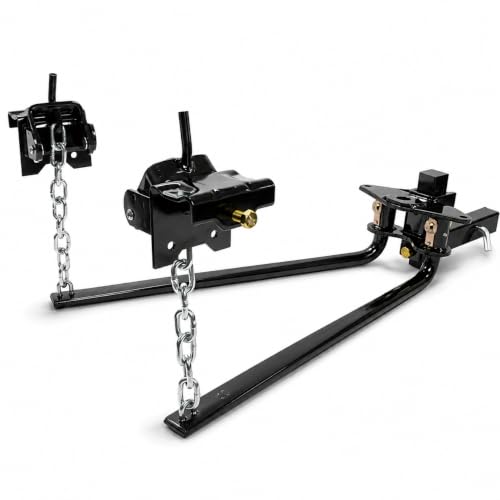
- HEAVY-DUTY WEIGHT DISTRIBUTION SYSTEM – Designed to distribute tongue weight more evenly across the tow vehicle and trailer, helping maintain a more level towing position while
- 1,000 LB TONGUE WEIGHT CAPACITY – Heavy-duty construction is engineered to support up to 1,000 lbs. of tongue weight, making the hitch suitable for towing travel

- Strong Traction: This weight distribution hitch is sturdy and well-designed, with a rated towing capacity of up to 14,000 lbs. This means that even when towing a heavy trailer or
- Balanced Weight: The weight distribution hitches with sway control can accurately coordinate the weight distribution of the trailer and the tractor, improve the control and
The Short Answer
Trailer sway is a side-to-side oscillation of the trailer around the hitch ball, and it almost always starts with too little weight on the tongue. Fix the load first, then add hardware. A trailer with roughly 10-15% of its loaded weight sitting on the tongue, packed heavy-low-and-forward, will resist sway on its own; a weight distribution hitch with integrated sway control is the reinforcement, not the cure.
Here's the thing most new RV owners get backwards: sway control gear cannot rescue a badly loaded trailer. It can only raise the speed and crosswind threshold at which a correctly loaded trailer starts to move around. Get the order right and the whole problem usually disappears.
The Problem: What Trailer Sway Actually Is
A travel trailer pivots on a single point — the ball. That makes the tow vehicle and trailer a two-body system with a hinge in the middle, and hinges oscillate when they're disturbed.
The disturbance comes from somewhere obvious: a passing semi's bow wave, a gust across an open plain, a downhill grade, a sudden lane correction. What decides whether that disturbance damps out or amplifies is where the trailer's mass sits relative to its axles.
Too much weight behind the axles lightens the tongue. A light tongue means the trailer's center of gravity is far back, the rear of the tow vehicle gets unloaded, front tires lose grip, and the trailer effectively starts steering the truck. Each correction feeds the next one. That's the fishtail people describe.
The Three Root Causes, in Order of How Often They Bite
- Insufficient tongue weight. The single biggest factor. Cargo loaded behind the axles is the usual culprit.
- Rear-biased or shifting load. Full fresh water tank behind the axles, generator in the rear bumper storage, bikes hanging off the back.
- Speed and aerodynamics. Sway forces scale sharply with speed. A setup that feels planted at 55 mph can be unstable at 70.
Step-by-Step: How to Load a Travel Trailer to Prevent Sway
- Weigh it. Get the loaded trailer on a scale, then measure tongue weight separately with a tongue scale or at a CAT scale. Guessing is how people end up at 6%.
- Target 10-15% tongue weight. Divide tongue weight by loaded trailer weight. If you're under 10%, move mass forward. If you're over 15%, you may exceed your hitch or vehicle rear axle limits.
- Put the heavy stuff over or slightly ahead of the axles. Batteries, tools, cast iron, water. Low on the floor, not in overhead cabinets.
- Keep the rear light. No generator, spare tires, or bike racks hanging past the rear bumper unless you re-check tongue weight afterward.
- Balance side to side. Uneven lateral loading makes the trailer track crooked and worsens sway response in crosswinds.
- Secure everything. A load that migrates rearward during a drive changes your tongue weight percentage mid-trip.
- Check tire pressures cold, at the sidewall-rated figure for the load. Underinflated trailer tires flex and add their own oscillation.
- Level the rig. A trailer nose-high shifts weight rearward. This is where a weight distribution hitch earns its keep.
Trailer Sway Control Explained: Friction vs Adaptive
Sway control hardware splits into two broad philosophies, and the difference matters for how you drive.
Friction-style sway control adds resistance at the pivot. A bar or a clamped surface makes it physically harder for the trailer to rotate around the ball. It's mechanically simple and it works, but the resistance is always there — including when you want rotation, like backing into a site or making a tight turn. Many friction units are disconnected before reversing.
Integrated or dual-cam style systems build the anti-sway action into the spring bar geometry itself, so the bars want to return the trailer to straight rather than simply resisting all movement. Manufacturers describe these as more "adaptive" because the corrective force is directional.
The listing for one of the kits below describes a "Four-Way Dynamic Stability System" that the seller says neutralizes inertia forces from all directions through reverse action and reduces lateral displacement during turns and lane changes [S4]. That's the manufacturer's framing of the adaptive concept — treat it as a design claim from the listing, not as independently verified performance.
All three kits here combine weight distribution with sway control, which is the right architecture for a bumper-pull travel trailer.
Tools and Products You'll Need
XtremepowerUS 1,000 lb Weight Distribution Hitch with Sway Control — Best for mid-size travel trailers on a 2-inch receiver
The number that defines this kit is its 1,000 lb tongue weight rating, which the manufacturer says makes it suitable for travel trailers, campers and utility trailers [S3]. Run that against the 10-15% rule and you get a practical ceiling: at 13% tongue weight, 1,000 lbs corresponds to a loaded trailer in the neighborhood of 7,700 lbs. Do that arithmetic against your own scale ticket before buying — it's an inference from the rating, not a manufacturer towing figure.
The shank is a 2-inch design for compatible 2-inch receivers with multiple adjustment positions for trailer alignment and towing height [S3]. The kit ships with spring bars, mounting brackets, chains, adjustment hardware and hitch components [S3]. Chain-and-bracket setups are conventional and serviceable, though they take more fiddling to dial in than snap-up designs.
One limitation worth naming: the supplied listing information does not state a gross trailer weight rating, only tongue weight. If your trailer is close to your tow vehicle's limits, you need that figure from the manufacturer before ordering.
VEVOR Sway Control Weight Distribution Hitch — Best for trailers with a coupler that needs a 2-5/16 inch ball
The VEVOR Sway Control Weight Distribution Hitch is listed at 1,500 lbs capacity — the listing does not state whether that figure is a tongue weight rating — and it ships with a 2-5/16 inch alloy steel ball [S4]. That ball size matters — it is not interchangeable with a 2-inch coupler, so confirm your trailer coupler stamp first.
VEVOR describes the unit as forged from high-tensile alloy steel with a double-layer electroplating process for corrosion resistance, and says the flat plate design reduces friction between components [S4]. Reduced component friction is an interesting design note for anyone who has dealt with the groaning of a friction bar in parking lots, though the listing does not quantify it.
Setup claims include an adaptive leveling system for height calibration and a tilt-head design allowing adjustment without disassembly [S4]. If you tow with more than one vehicle, or swap between a truck and an SUV with different receiver heights, tilt-head adjustment is the feature to weigh.
Weight Distribution Hitch with Sway Control Bar — Best for buyers who want a published gross towing rating
This is the only kit of the three whose supplied listing states both figures: a rated towing capacity up to 14,000 lbs and a tongue weight up to 1,200 lbs [S5]. Check the arithmetic — 1,200 on 14,000 is about 8.6%, which sits below the 10-15% target range. Practically, that means the hitch's tongue rating, not its trailer rating, is your real constraint on a properly loaded travel trailer.
The seller describes a separate sway control lever plus spring bars that reduce sway by increasing resistance [S5] — that's friction-style language, so expect to disconnect the bar before backing in tight sites. Six height holes in the square shank and a pre-installed ball round out the setup [S5].
One caution on brand: this listing carries no manufacturer name in its title. Buyers who want a documented warranty path should confirm that before ordering.
Tips for Best Results
- Set the hitch on level ground with the trailer coupled and both vehicles unhitched from any jack pressure.
- Re-measure ride height at the tow vehicle's front fender before and after tensioning bars. Restoring most of the lost front-end height is the goal.
- Slow down first when sway starts. Do not steer against it and do not brake hard with the tow vehicle. Use the trailer brake controller manual lever if equipped.
- Re-check tongue weight any time you add a generator, a second battery, or fill the fresh tank.
Common Mistakes to Avoid
- Buying sway control instead of fixing the load. Hardware raises the threshold; loading sets the baseline.
- Assuming a hitch rating equals your vehicle's rating. Your receiver, ball mount, vehicle payload and rear axle limit each apply separately and independently.
- Ignoring ball size. A 2-5/16 inch ball [S4] and a 2-inch coupler are not a match.
- Leaving friction bars engaged while reversing.
- Treating a corrosion coating as a maintenance exemption. These listings describe rust-resistant finishes [S4][S5]; they do not describe an inspection-free product.
How We Research
This site does not perform hands-on or laboratory testing. For this guide, we read the Amazon Creators API verified product records and the published listing feature bullets for each of the three hitch kits, retrieved 2026-09-10, and compared the manufacturer-stated tongue weight and towing figures against standard tongue weight percentage math. Where a listing makes a performance claim, we attribute it to the seller rather than restate it as fact. For general product safety recourse, CPSC and USA.gov consumer protection are the appropriate starting points.
Final Verdict
If your coupler takes a 2-5/16 inch ball, the VEVOR Sway Control Weight Distribution Hitch is the pick; its listing states a 1,500 lbs figure without specifying what that figure rates [S4]. For a mid-size trailer on a 2-inch receiver where 1,000 lbs of tongue weight is comfortably above your scale ticket, the XtremepowerUS 1,000 lb Weight Distribution Hitch with Sway Control covers the job with a complete component kit [S3]. The Weight Distribution Hitch with Sway Control Bar is the one to consider if you specifically want a published 14,000 lb towing figure alongside a 1,200 lb tongue rating [S5], with the caveat that the tongue number is the binding limit.
But buy the scale time first. Honestly — no hitch on this page fixes a 6% tongue weight.
Related Resources
- How to calculate tongue weight
- Travel trailer towing capacity basics
- Trailer brake controller setup guide
Sources & Methodology
No hitch on this page was physically installed, towed with, or lab-rated by this website — we have no test vehicle and no lab. What informed the recommendations above is close reading of each product's Amazon Creators API verified product record and its published listing feature bullets, retrieved 2026-09-10, with the stated tongue weight and towing capacities checked arithmetically against the tongue weight percentages that govern trailer stability. For weight distribution hitches specifically, that kind of specification analysis is genuinely decisive: capacity ratings, shank size and ball diameter determine whether a kit fits your rig at all, and those are exactly the facts a listing publishes. What it cannot tell you is how a given kit's bars feel to tension after a season of use — for that, confirm fitment and warranty with the manufacturer before ordering.